Chris' Story: “Because You Don’t Look Sick”, the Misunderstood Reality of Myeloma




Prior to diagnosis in June 2018, I would have visited my GP 13 times within a 9-month period, where I was initially misdiagnosed with a slipped disc and later misdiagnosed with depression due to incessant fatigue and low energy; I was consequently prescribed anti-depressants. I was also advised to limit any physical activities that would zap my energy. My job did not require any physical activities. I was on this anti-depressant for almost 9 months with no improvement. Unfortunately, one afternoon, I was playing with my then 2-year-old daughter and felt this terrible pain on my back to the extent of not being able to stand up or move around. I was eventually informed by the GP that I had fractured my spine in multiple places. I later found out this was due to the effect of multiple myeloma. I was sent for further tests, and I was finally diagnosed with stage 3 multiple myeloma and referred to the local hospital’s Haematology department for confirmation, treatments and necessary support.
Before this day, I had no idea of what multiple myeloma was until I met with the medical team, where I was given all the information regarding my diagnosis and informed about treatment options available to me. Eventually, I was admitted into the hospital for my first ever chemotherapy. I was made aware that my light chain number was higher than normal, and the cancer had developed into stage 3. This was partly due to delay or late diagnoses. The Haematology Consultant and his team supported me and my family during my time in and after I left the hospital. I was very lucky to work with a medical team that looked out for me and treat me with respect which helped me to navigate the situation. The initial treatment and hospitalisation lasted 26 days in which my spine fractures were gradually healed but it resulted in my height being reduced from 181cm to 177cm as confirmed by my medical team, perhaps one of the most annoying outcomes of the journey at the time.
"As a man that is conscious of healthy lifestyle, I was extremely angry and sad about the diagnosis, believing it was very unfair, but I realise afterwards that while healthy living is amazing and help us to live a healthy life, it’s not a panacea to cancer-free life."
I was in denial of my situation for over 6 months, pretending that I could never have cancer, that it was just a misdiagnosis by my doctor which will be corrected in due course. I later realised cancer is a respecter of no one, and does not exempt anyone regardless of the age, gender, ethnic background or social economic status. Cancer underscores the need for preventative measures.
Late 2018, I went through a Stem Cell Transplant Procedure (SCT) - this involved harvesting stem cells, conditioning treatment, high-dose chemotherapy, and then infusing the stem cells back into my body. I spent 23 days including Christmas and Boxing Day in the hospital while recovering from this procedure due to numerous side effects. I was eventually discharged mid- January 2019.
Recovery was painfully slow as a result, I lost over 35% of body weight and one of the side effects was perpetual vomiting which made it hard to put my weight back on. It took an additional 16 weeks to fully recover and I was able to gradually return to normalcy. I was declared to be in remission.
Unfortunately, a few months after the SCT, I relapsed, I was frustrated and scared of going through the same painful process again. I was enrolled in a trial treatment which lasted about 3 months. The disease was placed under control after the completion of the trial.
"The hardest part of the situation was heavily relying on people for every basic chore without being able to reciprocate due to lack of mobility. My little daughter was growing up and using her early childhood believing that she has a very sick father unlike her classmates. She eventually developed separation anxiety."
This has affected her sense of security, as she now finds it difficult to part with me and always asking if I am going to be in the hospital before she finishes from school. This has always broken my heart.
"It was also difficult due to COVID 19 pandemic restrictions, and I had to go through all this treatment with minimal visitation from family and friends. My family were advised not to visit due to fear of infections. Being in isolation was one of the worst parts of my journey."
I eventually developed claustrophobia, always looking for an escape route whenever I entered a room and never going into small spaces. For whatever reason, even lying down in a PET scan machine now scared the hell out of me, I'm still struggling with this phobia to date.
During one of my scheduled chemotherapies, right on the treatment chair, I received a phone call that my loving father had suddenly passed away, the man that stood by me and gave me hope that everything will eventually work out, just went to sleep and never woke up. I was very distraught, I really wanted to give up on life because my situation was getting worse in every sense. I was very angry with everything and with everyone but sadly due to COVID-19 restrictions I was unable to safely travel out of the country to bury my father. There is a limit to human perseverance. But, giving up on life and my family was not an option I was willing to take. It would be extremely unfair to my 3 children, 16-year-old male, 13-year-old female, and 3-year-old female, at the time who saw me as a role model and hero, so I have to continue the fight. Although, I thought of stopping all forms of treatment and letting nature take its course. I carefully considered the options of quality of life without treatment including the time to spend with my family or continue with the treatment and have a diminished quality of life. At this time my medical team, especially the Consultant, encouraged me that there are so many treatment options available and many ongoing studies which I cannot benefit from if I give up on the treatments at this stage. With the full support of my wife and children I continued with the treatment options available which happen to be the correct decision despite the challenges of having to deal with numerous side effects. The remission only lasted for a few months.
By August 2021, I relapsed again. I was advised to self-medicate using a multiple myeloma medication combination, to be used at home and visit the Haematology department only when necessary. At this time, I had the worst feeling of abandonment and the fear that I would not receive the care I needed due to COVID 19 restrictions at the time, unfortunately the remission only lasted for 13 months.
By September 2022, the cancer relapsed again, and I was offered a clinical trial at a cancer hospital in Manchester, UK. I had a lot of side effects while going through this treatment, which included, but were not limited to, loss of sense of taste for over 3 months, almost going blind and my skin peeling off in the process. The trial placed the disease under control but my quality of life was negatively impacted due to so many side effects. I was withdrawn from the clinical trial a few weeks after, as the side effects were overwhelming. For some reason I have not required any form of treatment as the multiple myeloma has been consistently under control despite my withdrawal mid-way from the clinical trial and I hope it stays the same for a very long time. I have met a lot of professionals along the way. People who actually help me to navigate my new realities.
My message to others who have been recently diagnosed
The day I was invited to the GP’s office for my diagnoses was just like any other day. The doctor casually told me I might have multiple myeloma based on the results he had so far. He also explained that the multiple myeloma screen test was only conducted for people that are older than my age, at the time I was 39, hence the reason for delay in diagnosis as there was a belief that the disease majorly affects older people. Unfortunately, My GP also had limited knowledge about multiple myeloma and was unable to answer most of my questions at the time. I actually thought that a simple medication can cure multiple myeloma due to not having any knowledge about it because it was the very first time I heard about it in my life. However, the GP referred me to a local hospital’s Haematology department for the further information and support I might require.
I lived in denial of the illness for months; I kept telling myself that it can never happen to me especially since I have no history of the illness in my extended family, and I could not understand why it should be me. I live a healthy Life, no smoking, no drinking, regular exercise and eating healthy, so I was very disappointed that despite all these, I was still diagnosed with a major illness at 39. I was extremely angry with everything and everyone because I could not see myself losing control of my own care to anyone else or become a burden to my family no matter how close they are.
Also, my parents and siblings have no idea how to support me as they have no knowledge about multiple myeloma which created a big rift between us.
However, my nuclear family stood by me 100% and I have to continue to fight and take advantage of available treatment and lead a normal life like everyone else, so I attended all the scheduled appointments and followed medical advice from the professionals, focusing on my children as the reason I was going through the treatment. Every extra minute I spent with them gives me the strength to keep going. If you do not have a purpose, you will find a million reasons to give up on life.
Also, my medical team gave me all the support and encouragement I needed to keep going and realised that I have a lot more to fight for. My father was one of the people that encouraged me not to give up on life until his death during the most vulnerable period of my life.
"Also, my employer played a vital role in making me remain positive as I was not economically burdened while undergoing treatment as they paid a huge percentage of my salary while I was hospitalised. This could have had a negative effect on me as I grew up believing that a man that cannot provide for his family is not a complete man. So, my employer played vital role in helping me to cope with my circumstance." "Finally, I have visited 5 different countries since my diagnosis, and I am looking forward to many more. Also, I am currently enrolled in a master’s degree programme in one of the UK’s University because I have decided not to allow multiple myeloma to deter me from achieving my dreams and life plans. I believe in indulging myself in whatever makes me happy."
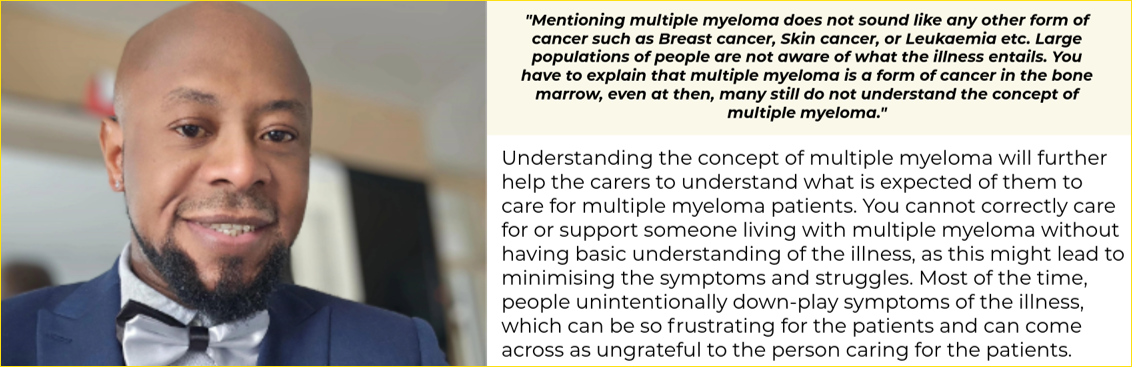
If I told family and friends that I am in the hospital for any reason, the response is usually that of scepticisms or confusion. Asking why I spend so much time visiting the hospital. This has caused quite a rift between one of my relatives that thinks I should stop being dramatic and man up. A very frustrating situation.
Thankfully, 7 years since I was diagnosed, my partner has never shown any weaknesses, at least not in my presence and has never judged my situation. She plays a prominent role in all my medical decisions. She listens, asks relevant questions about treatment plans, is 100% committed to our relationship and helps me to navigate my current realities. Any sign of hopelessness from my carer or partner could have negatively impacted my medical situation. Therefore, support from family and friends are very essential while living with multiple myeloma.
Also, it is important that a mental health specialist should always be included and allowed to be involved in the medical decisions of multiple myeloma patients from the beginning of the journey to the end, provided the patients consent to such arrangement. Living with multiple myeloma requires not just physical and economic support but requires emotional and psychological support as well.
"People use statements like ‘you don’t look sick’ or ‘you look well to be sick’ especially after completing a rigorous chemotherapy. Some will go as far as comparing your recovery/illness with someone they used to know. Whereas every journey is completely different from one patient to another, most of the time I have to explain the illness to some people, yet their ignorance is very astounding. I wish there is enough awareness about multiple myeloma like other cancers as this will help the carer or family members to understand how to support the patient."
My message to others who have been recently diagnosed
Treatment for multiple myeloma is evolving and there are many treatment options at trial level or totally available to you. Unlike a few years ago where multiple myeloma diagnosis was seen as a death sentence, not anymore, there are multiple treatment options that can keep you in remission for a very long time. As a matter of fact, some patients have been in remission for over 10 years and leading a normal life.
"We as patients or careers are used to giving doctors, nurses or medical team members, negative or positive feedback for the services rendered while we are undergoing one form of treatment or another. However, if the medical team members were allowed to give you feedback as a patient, would it be positive or negative? We are expecting professionalism from our medical team, but we have to show professionalism as patient in return."
I understand that, as a result of your diagnosis, you are going through multiple stages of emotions and it can be overwhelming, but your medical team are only there to help/support you. Over time, I have built a great professional relationship with my medical team, we treat each other with respect and complete trust. A positive relationship with your medical team will help you build trust and, as a result, you will build a very good support system which will include your medical team.
Also, life troubles will not stop because you are diagnosed with multiple myeloma, everything good or bad that is meant to happen to you will certainly happen. The larger your support system, the easier it will be for you to navigate the dark period in life. In my case, when I received a call about my dad’s death while on the chemotherapy chair, my nuclear family and medical team helped me through the most difficult period of my life. At this time, I had reason to give up, but the support system I built was strong enough to withstand the pressure of giving up. Everything will come at you when you are down, death in the family, illness in the family, economic disaster etc. . Some people will disappear from your life during this time, but the real ones will be there to support you. Please appreciate them, they genuinely care for you.
I cannot tell you that the journey will be easy, but you have to focus on the positives. Some people might give up on you especially when the pressure is high; be mindful that the people you are expecting to be part of your support system might not be strong enough to play this role when the time comes. Please take advantage of all the available resources as these will help you to navigate through the journey.
Every journey is different but always keep in mind that as you are attending to your physical wellbeing, do not neglect your mental and emotional wellbeing.
"Do not let the multiple myeloma destroy your dreams and plans for the future. You are still the architect of your destiny irrespective of your diagnosis. On a personal note, I am currently studying for my master’s degree programme despite the illness. Live your life as you initially planned before you were diagnosed and remember you are stronger than you think."
Good luck in your journey.