Paula's story: From Lymphoma to Myeloma, navigating a double diagnosis


My journey with Myeloma had a more unusual start than most. Following a diagnosis of Non-Hodgkin Lymphoma (NHL) due to a lymphoma behind my right eye, I had a PET CT scan and bone marrow biopsy. My haematologist rang me at 6pm one evening to tell me the scan hadn’t identified any additional lymphomas but ‘there was a bit of a problem with my blood plasma’ that he would discuss the following week. The significance of this piece of information passed me by and I duly went off to my next appointment alone under the illusion that we would mainly be talking about the radiotherapy I was to have for the lymphoma.
On arriving at my appointment, I was met by both my specialist nurse and my haematologist who remarked on the fact I was alone. It was at this point that I realised that the ‘blood plasma problem’ carried more significance than I had attributed to it. I had Lambda Light Chain Myeloma which, although treatable, was incurable. Was I shocked or upset? No; I had already come to terms with one cancer diagnosis and now I just had two to deal with. I was more concerned about the 12 sessions of radiotherapy I was to have. One step at a time I told myself.
As I didn’t start treatment for Myeloma straight away it gave me time to read and assimilate all the information I was given from Myeloma UK. Myeloma is complicated and everyone has their own individual experience; it takes a while to get your head around the science of it all. As an academic being informed makes me feel more in control and this enabled me to have more productive conversations with my haematologist when the time came to discuss treatment. I tend to just get on with things; you have to deal with the cards you are dealt the best way you can, and this will be different for everyone.
Unfortunately for me my journey wasn’t to be straightforward. Three different drug combinations over 6 months failed to bring my light chains down. Cytogenetic abnormalities are often responsible for myeloma being unresponsive to treatment, but this didn’t apply to me. Eventually further pathological investigation discovered CD20 (a surface protein found on B cells). It’s primarily known for its role in B-cell malignancies such as lymphoma; it’s rare to find CD20 expression on myeloma plasma cells and the exact role of CD20 in myeloma development and progression is unknown.
My specialist contacted other specialists to determine if there was any experience of this out there. The treatments I was prescribed, succeeded in getting me to stem cell transplant (SCT). I can’t help thinking that if they had looked more thoroughly at the pathology in the first place I wouldn’t have wasted all those months on treatment combinations which were never going to work.
SCT was tough, as it is for many. I spent 8 weeks in hospital due to the fact I caught RSV whilst in hospital, which is dangerous when you have a non-existent immune system. I lost two stone, which I didn’t have to lose, and recovery was very slow. My SCT was in January 2019, and I’ve been in remission since, of which I am very grateful. Seeing as my Myeloma follows a different disease course and response to treatment no one knows what treatment would be appropriate should I relapse. Therefore, unlike most people with Myeloma I don’t have the certainty of knowing there will be a second or third line treatment waiting in the wings for me.
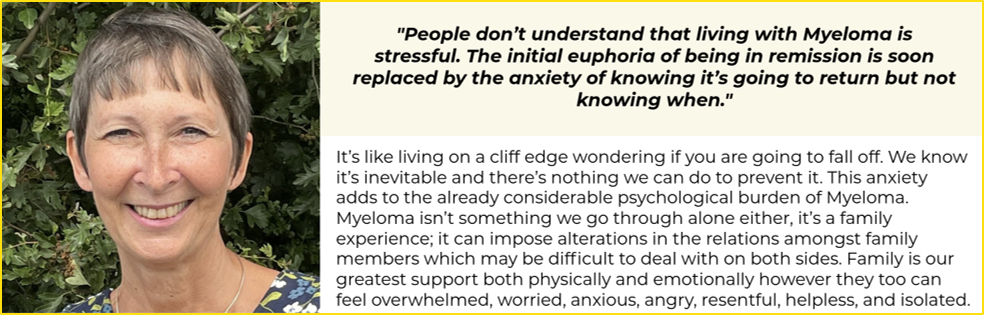
There isn’t room here to discuss everything I would say to someone newly diagnosed but my initial advice would be to focus on understanding the condition by accessing the excellent information from Myeloma UK and the treatment options available to you. Having a good understanding of myeloma helps you to have more informed discussions with your consultant.
"Myeloma is as individual as you are; don’t expect it to always follow the same pattern as someone else."
Lastly seek emotional support and ask for help if you need it.