Making treatment decisions together


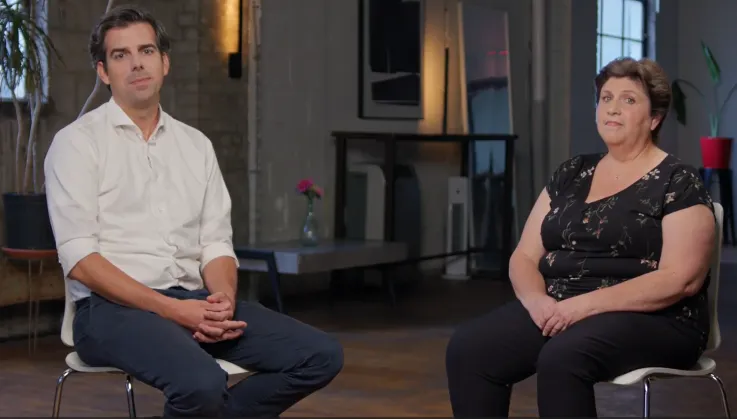

Understanding more about shared-decision making through a real-world conversation
In the video below, Donna shares her experience of living with multiple myeloma. She speaks with a hospital cancer specialist Dr Max Mertz, about why it is important for patients and healthcare teams to make treatment decisions together.
Donna talks about how treatment can affect everyday life, including family, work and wellbeing. Dr Mertz explains how doctors look at test results and treatment options, but also why listening to what matters to the patient is just as important.
The video encourages open and honest conversations, asking questions, and choosing treatment plans that fit around a person’s life. It reminds patients that they are more than their diagnosis, and that care should be planned with them, not just for them.
Hello, my name is Donna.
I live with my husband and our pets Mocha Bean and Maui.
I am a mom, a daughter, a grandmother, a wife, a sister and a friend and I have multiple myeloma.
In 2019, I was diagnosed with multiple myeloma, high risk, aggressive and currently I am on my fourth line of treatment and I'm Doctor Max Mertz, A haematologist, oncologist practicing in New York.
Although Donna is not my patient, we are teaming up to talk about the importance of sharing treatment goals between patients and doctors and myeloma relapses or becomes refractory to treat.
So for me, shared decision making, it's important because I'm the person going through it.
I know the doctors have all the expertise and all the knowledge and we appreciate that, but you don't live with it day by day.
You know, you don't see what happens when we get up in the morning and things like that.
So having that shared decision making and having the doctors listen to what we're saying and how we're going through it and under and, and trying to work with us is huge from a patient perspective.
Yeah, I think it's very important because as you mentioned, we try to focus of course a little bit on the myeloma side when we make the decision to see, you know, what kind of prior treatment did you have, what kind of experience was your first line of treatment, for example?
But it is very important to get to know your experience and your wishes for the next line of treatment as well, because nowadays we have so many different options.
And I think it's very important to make the right decision for you because all patients are different.
Yeah, I think, you know, going from stage to stage to stage, is it there are, there's, there's so many things that happen that I like, you know, you take into the as a patient, you take into consideration like when I have my transplants just by coincidence or I was not a bit able to get anything close to home and it's 3 weeks.
Like, I mean, that's a long time to be in a hospital, but I think, you know, having all those different options and learning about them and knowing about them, I think is what's important.
And one thing that we always have to keep in mind, you know, of course we can make a plan for you, but we have to figure out how it actually is applied in your real, real life, you know, because if you make a plan that sounds perfect, but for example, you still need to work or take care of it and whatnot, we have to make it work around that, not you.
You're not supposed to live your life around our treatment, but we have to arrange our treatment around your life.
I really appreciate you saying that because we are, we have multiple male only, yes, but that should not define us.
I'm still me, I'm still a mom, I'm still a wife.
I'm still, you know, it's not, I'm not the cancer patient.
I'm, I'm Donna.
No, it's a great point because all the things that you said, you know, your wife, you're grand mom, your friend.
Your also maybe sometimes just know you want to go to work, for example.
And that's very important.
Even going on vacation sometimes because if you are able to, to, to do your treatment and to adhere to the plan that we come up with together, then we get the best results.
You know, if I come up with a plan that doesn't work for you, the plan won't work.
Even though my ideas might have been, you know, great ideas or have been shown in clinical trials that they are effective, but we have to work together to get the plan, best plan running for you.
And because of that, we need to talk to each other.
When deciding on the next treatment for a patient with relapse and refractory multiple myeloma, I review the patient's previous treatments, how their myeloma responded, and any side effects they experienced.
I also examine their myeloma disease features and overall health, along with clinical trial data and guidelines.
Together, this information allows me to narrow down the list of potential treatment options.
I present these options to my patient along with practical information like side effects, how often the treatment should be taken, and if a hospital stays required.
Our discussion is my opportunity to hear my patient's needs and preferences and answer questions they may have.
My doctor and I go through a similar process.
I found that there was a lot of information to take in, especially when I was being affected by chemo fog and was struggling to remember things.
Now I write everything down, even if it's a question that occurs to me at AM so that I remember to bring it up during my doctor's appointment.
I've also learned to be persistent and asked for clarification if my doctor says something I don't understand at first.
Finally, I bring a loved one with me to be my ears during my doctor's visits.
Don't be afraid to reach out.
There are people who can help you.
For instance, my patient support group has made a huge difference in my life.
Also, build your support network like your family and your primary nurse. Right?
And treatments are not one-size-fits-all.
By discussing your needs with your doctor, you are helping to find the best treatment for you.
Finally, I'd say approach the journey one step at a time.
It's not going to be easy, but if you take things one day at a time or even 10 minutes at a time, it becomes doable.
And with each step there is a reason to stay helpful.
Making decisions with your healthcare team
Shared decision-making ensures that people living with cancer (or another illness) fully understand the options available to them and have the opportunity to actively take part in decisions surrounding their treatment and care.1,2 Shared decision-making is important to ensure any decisions that are made are right for you, based on how you are feeling and what you want.2
A shared decision-making conversation brings together:2
- The doctor, nurse or other healthcare professional’s expert knowledge on treatment options, including their benefits and risks
- Your preference, personal circumstance, wants and needs
Many of the doctors, nurses and other members of your healthcare team will be aware of the importance of shared decision-making. They will include you in conversations, rather than making a decision on your behalf. But for some healthcare professionals, shared decision-making might be an afterthought. If this is the case, don’t be afraid to speak up. Be sure to ask about anything you’re not sure of and do voice your opinion. These are your decisions too!
References
- National Institutes for Health and Care Excellence. Shared decision making. Available from: https://www.nice.org.uk/about/what-we-do/our-programmes/nice-guidance/nice-guidelines/shared-decision-making [Accessed June 2025].
- NHS England. About Shared Decision-Making. Available from: https://www.england.nhs.uk/personalisedcare/shared-decision-making/about/ [Accessed June 2025].