

How diversity in clinical trials makes healthcare more equal
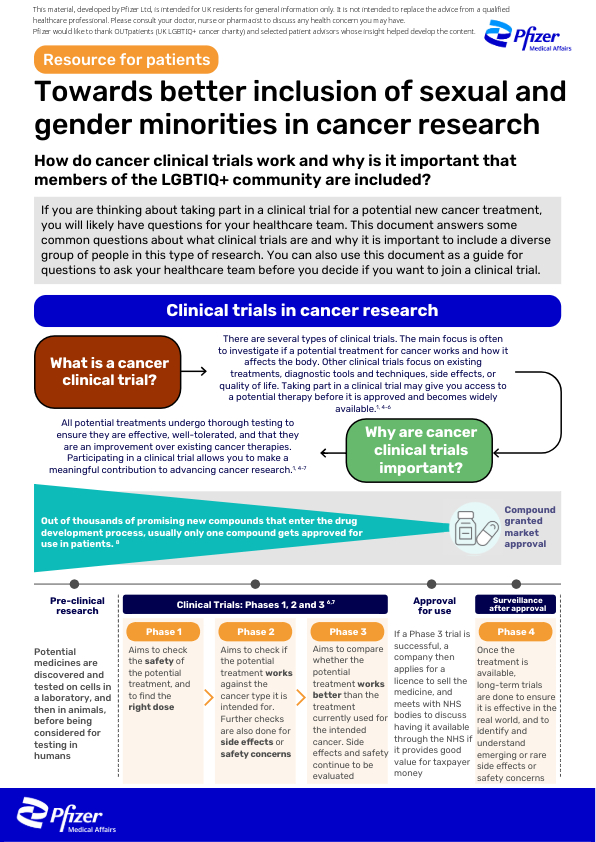
Clinical trials are a way for researchers to test potential new medical treatments.¹ To understand how these treatments work in different people, clinical trials should include and represent all kinds of people.² This inclusivity – bringing together participants of different ages, ethnicities, genders and backgrounds – is called diversity.
Here’s why diversity in clinical trials is important, and why it matters.
Healthcare that works for you and others
Everyone responds to illnesses and treatments differently. Things like age, gender, and ethnicity can influence your likelihood of developing certain diseases and affect how your body reacts to medication.² This is why it’s so important to include wide range of people in clinical trials.
Why everyone matters
Diverse representation in clinical trials doesn’t just help individual participants – it can have widespread benefits. For example, a new treatment that has been tested in a diverse group could show benefit in a broader population compared to a treatment tested in a less diverse group.3
Informed consent
The term “informed consent” is important in clinical trials – but what does it mean?
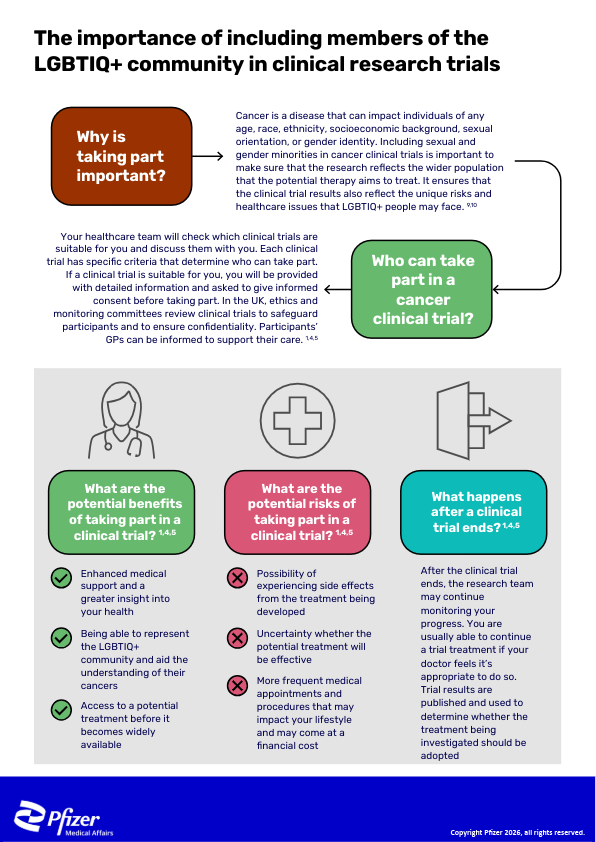
Informed consent is the process of making sure you fully understand the details of the clinical trial before you agree to take part. A member of your healthcare team should explain the aim of the trial, what taking part involves in terms of appointments, tests and assessments, and the potential risks and benefits associated with joining.⁴
Interpreters or written translations should be available for people whose first language isn’t English, to help with understanding every detail of the clinical trial.4
Moving towards a fairer healthcare
Thankfully, diversity in clinical trials is no longer just a recommendation – it’s becoming the norm. Focus is being placed on making sure people – regardless of background – know that clinical trials are available, and they have a fair chance to take part.3,11
Why taking part matters
Joining a clinical trial is a meaningful way to help improve healthcare. It may offer you access to potential new treatments while also helping researchers develop better medicines that could benefit people for years to come.4
If you are interested in taking part in a clinical trial, speak to your healthcare team. They will be able to talk to you about which clinical trials may be suitable for you.
If you haven’t already, then take a read of the Understanding clinical trials article to learn more.
If you would like to find out more about the importance of ethnic diversity in cancer clinical trials, read the articles below. These are available in English, Polish, Urdu and Romanian.



- Macmillan. Cancer clinical trials. Available at: www.macmillan.org.uk/cancer-information-and-support/treatments-and-drugs/clinical-trials [Accessed March 2026].
- American Association of Critical-care Nurses. Why diversity in clinical trials matters. Available at: https://www.aacn.org/blog/why-diversity-in-clinical-trials-matters [Accessed March 2026].
- Clinical Research News. The importance of diversity in clinical trials: A comprehensive analysis. Available at: www.clinicalresearchnewsonline.com/news/2023/11/21/the-importance-of-diversity-in-clinical-trials-a-comprehensive-analysis [Accessed March 2026].
- The UK Clinical Research Collaboration. Understanding clinical trials. Available at: iCT_Booklet.pdf [Accessed: March 2026]
- Macmillan Cancer Support. Taking part in a cancer clinical trial. Available at: Taking part in a cancer clinical trial | Macmillan Cancer Support. [Accessed March 2026]
- Cancer Research UK. What are clinical trials? Available at: What are clinical trials | Cancer Research UK [Accessed March 2026]
- Cancer Research UK. Phases of clinical trials. Available at: Cancer Research UK | Phases of clinical trials. [Accessed March 2026]
- Kraljevic S, et al. EMBO Rep 2004; 5(9):837-42 Available at: Accelerating drug discovery - PMC [Accessed March 2026]
- Griggs J,et al. J Clin Oncol 2017;35:2203–8. Available at: American Society of Clinical Oncology Position Statement: Strategies for Reducing Cancer Health Disparities Among Sexual and Gender Minority Populations | Journal of Clinical Oncology [Accessed March 2026]
- Versavel S, et al. Contemp Clin Trials 2023;126:107092. Available at: Diversity, equity, and inclusion in clinical trials: A practical guide from the perspective of a trial sponsor - ScienceDirect [Accessed March 2026]
- Acuña-Villaorduña A, et al. Equitable access to clinical trials: How do we achieve it? American Society of Clinical Oncology Educational Book 2023;43:1–8. Available at: https://ascopubs.org/doi/10.1200/EDBK_389838 [Accessed March 2026].