Andrew's story: patience, perspective and a glass half full



Can you tell us a bit about your journey with lung cancer?
My journey with cancer started in February 2023. I became quite unwell and, after doing a COVID test, found I had COVID. It knocked me out for a few days, but I started to feel a little better, though I was still breathless and not quite my usual self.
I had been a runner for around 15 years, typically doing 5K and 10K runs on my lunch breaks.
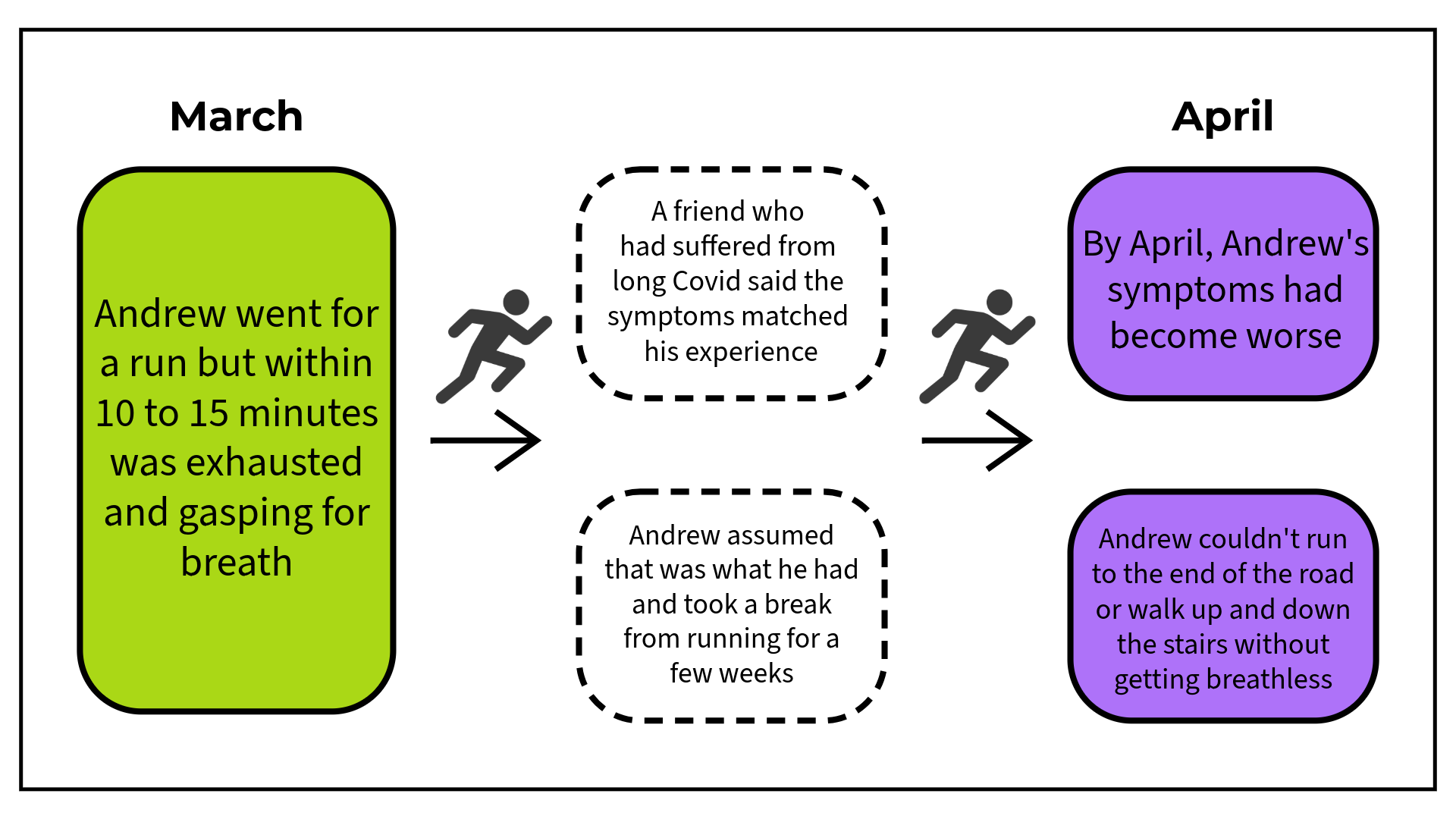
View the visual timeline below to learn how the effects on Andrew's running led him to seek medical advice:
I eventually went to the doctor in May. They listened to my chest, said it sounded a bit crackly and quiet in my lower right side, and thought it might be COVID-induced asthma. The inhalers they prescribed did nothing, so I went back a week later and saw a different doctor, who referred me to hospital for an ECG and blood tests. These revealed a high level of clotting markers in my blood, and a CT scan found a pulmonary embolism (a blood clot that blocks blood flow to an artery in the lung), affecting both lungs. I was put on emergency blood thinners, kept in hospital for a few days and further exploratory tests were planned.
Due to the risk of bleeding while on strong blood thinners, those tests were delayed by several weeks.
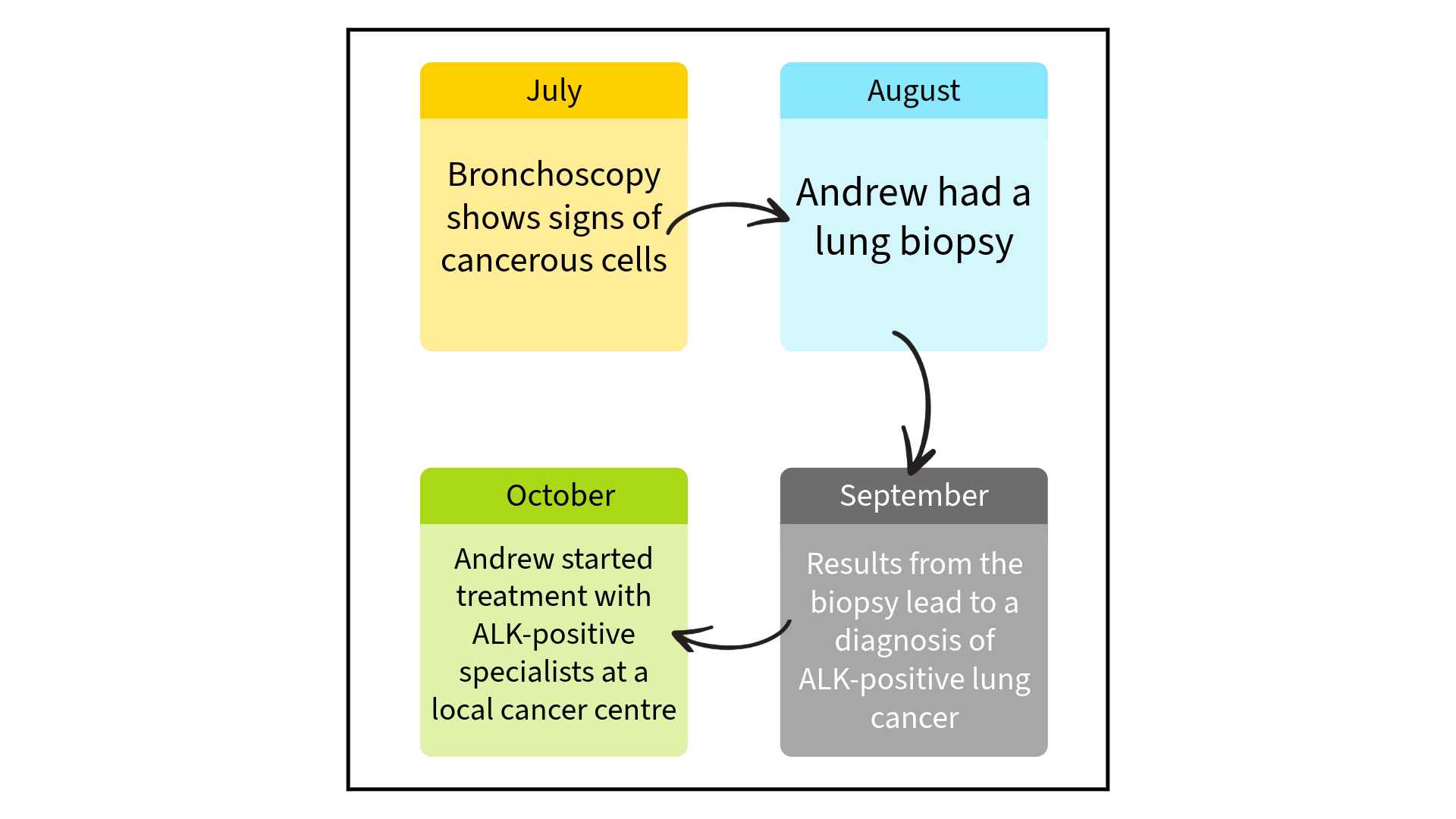
View the image below to learn more about the exploratory tests Andrew underwent:
What are some challenges you've faced along your journey, and how have you stayed positive?
There is obviously that initial shock when you're told you have cancer. Typically, people assume it means weeks or months to live. But I was positive about the treatment from the start. I researched the consultants at my local centre and found they were highly experienced specialists in ALK-positive cancer, which gave me a lot of optimism. I'm also a fairly optimistic person by nature; I tend to see the glass as half full rather than half empty. So I thought:
"I've got cancer, it's not going to go away, I just need to get on with it and focus on the right course of treatment"
It's a strange thing to live with. Sometimes it comes into my mind and I think about how long I might have. But then another part of me says: you're okay right now, so just enjoy life. Get out there and do the things you want to do. Enjoy the life you've got rather than spending it worrying about how long you've got left. It does get stressful around scan time. I have CT scans every three months, so it never truly goes away. But on the whole, on days that aren't scan days, I'm generally not thinking about it too much.
I've been fortunate that my treatment has gone very well over the past two and a half years so far. Most of the tumours that were in my lungs have gone. I still have a primary tumour, but it's at a manageable size and sitting dormant. The treatment is still working for me and keeping the cancer at bay. I try not to dwell on it too much and just get on with life.
What do you wish more people understood about living with ALK-positive lung cancer, or cancer in general?
The assumption that if you have lung cancer, you must have been a smoker. Almost everyone I've told has asked, "Did you smoke?", as though I caused it myself. I've never smoked in my life. ALK-positive lung cancer, along with numerous other types of lung cancer, is caused by a genetic mutation. It's not something you've brought on yourself.
The other thing I've found strange with ALK-positive cancer is that, because of the treatment options, people tend to forget that you still have cancer. I don't necessarily want them to ask about it every single time they see me, but there's an odd mentality that sets in:
"You look fine, you're wandering around as normal, doing normal things, so you must be okay"
But it's still there. It hasn't gone away. I often wonder how people will react if my treatment stops working. Will it be like announcing that you’ve got cancer all over again?
What message would you like to share with others who have been newly diagnosed or are living with the condition?
When lung cancer is detected in a patient, you may be told you need to get your affairs in order or start making do-not-resuscitate plans, as if your life is about to end within months or even weeks. If you've been diagnosed with lung cancer and you're not sure what you're dealing with, it is valuable to seek a second opinion and additional support. Find out exactly what type of lung cancer you have, because that determines what treatments are available to you, and whether you need to be thinking in terms of weeks or potentially many years.
I was very fortunate to be treated at a centre where the team are experts in ALK-positive cancer and I received an excellent diagnosis and treatment plan, but this is not always the case. So my message is:
" Stay positive, seek a second opinion, and keep pushing until you have the full picture"
Your diagnosis might not necessarily be what it first appears to be.
The stories shared on this website are personal experiences, written in the patients’ own words. They reflect individual journeys and should not be considered medical advice or representative of all patient experiences.
Any images featured have been shared by the individuals themselves and are used with their explicit permission.