Bronagh's story: from retirement to diagnosis




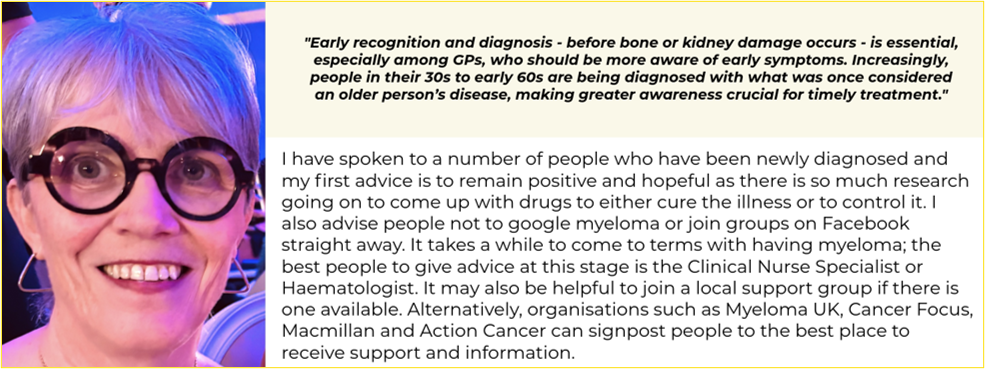
I had just turned 60 when I was diagnosed with Multiple Myeloma on 9th January 2023, just 2 days before I was due to fly to Australia for a 3-month holiday. The holiday was to celebrate my retirement from a very stressful job in the NHS and had been delayed from 2020 due to COVID and lockdown conditions. Although I hadn’t been feeling well for a period of time, I didn’t think there was anything seriously wrong with me. My issues were intermittent infections and increasing tiredness that I didn’t really attach any significance to. Despite this, I was probably fitter than I had been at any other time in my life. I joined a gym at the end of 2019 and had been attending sessions 3 mornings per week (during lockdown these were online). I had lost 4 stone in weight through a complete overhaul of my diet and increasing my fitness levels through exercise.
I first contacted my GP about a food poisoning infection I picked up in November 2019; it was Campylobacter and it took a course of antibiotics and approximately 3 months to fully recover. Following this through 2020/21 and 2022 I contacted my GP on several occasions with variety of non specific symptoms and infections. I was referred to several specialists over this period to investigate possible causes of symptoms and each time nothing was diagnosed. I was eventually referred for a colonoscopy to explore a possible cause for a slowly falling blood count. However, the consultant I was referred to decided to refer me to a haematologist to investigate what he described as a strange pattern of blood results. I first attended the haematology department in December 2022. While my blood count was slightly below normal and my neutrophils were also slightly below normal I was advised that I would be seen again in 4 weeks. I was surprised at this as I was actually feeling well and I felt I was taking up time that other people needed more than me. When I was seen again in early January 2023 my blood count had dropped further, and I had had two infections since my last visit in December. I was again told I would be seen in one month and there was a possibility of having further investigations and blood tests if my blood count continued to fall.
It was a couple of days later that I received a telephone call from the haematologist advising that she had done some further tests on my blood and the results were concerning. She invited me to come into the hospital for a Bone Marrow biopsy. As I have a health care background, I surmised that we were talking about Multiple Myeloma from what she had said, although this wasn’t confirmed until a few days later. Since this time, I have had 6 months of weekly chemotherapy sessions followed by a stem cell transplant in September 2023. I am now on maintenance treatment and living well with my illness. I am feeling positive about the future as I know that progress is being made towards better treatments and possible cure for myeloma. I do suffer from fatigue which can be overwhelming at times, however I keep my self-busy doing things I enjoy and things that challenge me. I have met amazing people through my journey with Myeloma who I would not have met had I not been diagnosed and my life is fuller because of them.
Throughout my experience with Myeloma I have stayed positive mainly by talking with my Haematologist about the new treatments that are coming on line to treat Myeloma. I have done a fair bit of reading about the progress that has been made in recent years. I have also become involved with Myeloma UK sitting on its Advocacy panel and I am currently undertaking the Advocacy Development Programme with Myeloma Patients Europe (MPE). I have met a number of people who are living with myeloma through these ventures and particularly through the MPE Advocacy programme I have become aware of the ongoing trials and progress being made towards possible cure.
Myeloma plays a big part in my life as I live with it and I don’t let it take over or define me. I have to find ways of managing my tiredness so that I remain in control and don’t let the illness control me. I am living a full life and eventually had my trip to Australia for one month in 2024. I have had a few other overseas holidays also and I am planning a trip to Greece in October 2025 and hopefully Japan sometime in 2026 and back to Australia in 2027. I am also enjoying my VESPA 125 scooter which I had bought myself for my 60th birthday – I hadn’t been able to ride it during my treatment which was a big disappointment.
Prior to my diagnosis I had only known one person who had Myeloma. This was the mother of a friend of mine. She was in her forties at the time in the late 1980s and she died relatively shortly after her diagnosis. My memory of that time is that she had suffered a lot of pain. I had also watched an episode of "Call the Midwife" in which a character had died following a diagnosis of Myeloma; it was a distressing watch at the time although I reminded myself that it was set in the 1960s and treatments have come a long way since then. However, when I was diagnosed these were the two images that came to my mind immediately. Therefore, the main thing I wish that people understood about living with myeloma is that people do live with Myeloma. It is not a death sentence, the progress being made with drugs to slow down the progression of the disease and to treat the symptoms has been remarkable.
"However, I do think that it is important that people understand is that it is a condition that once diagnosed a person has for life. It cannot be cured but the treatments help to control it and slow down its progression."
Although remission can be achieved individuals with Myeloma are frequently on either maintenance drugs or undergoing treatment for relapses. These treatments including the maintenance drugs result in fatigue and while an individual with myeloma can frequently look well and live a near to normal life the overwhelming fatigue is often not recognised or understood.